


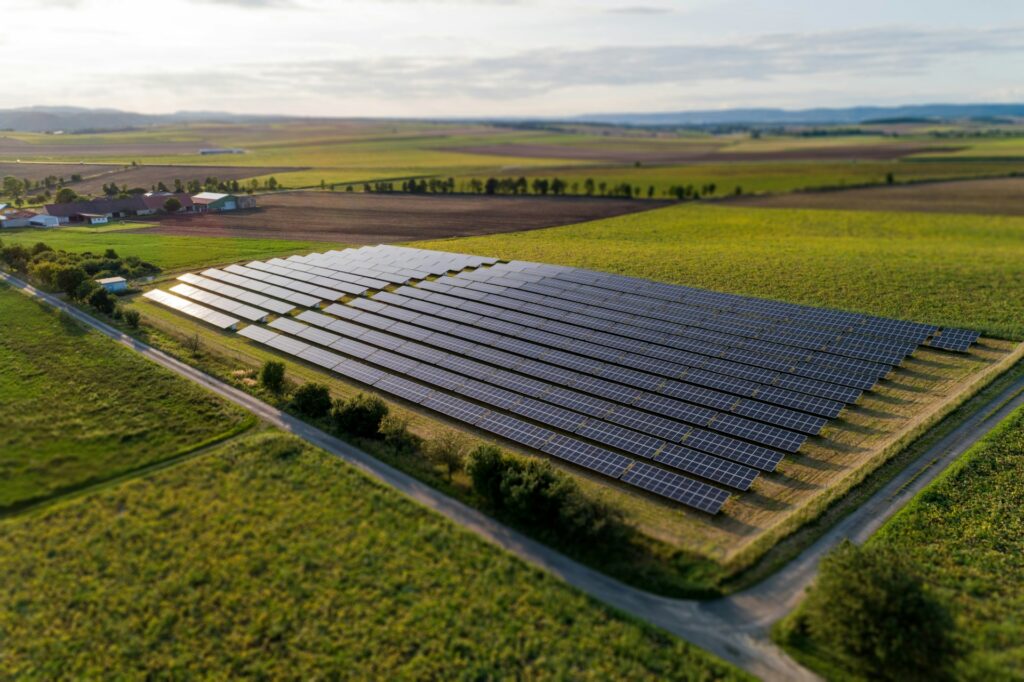
When a project developer approaches the owner of an arable field, six-figure sums are quickly at stake – along with commitments of 30 years and more. For banks, communities of heirs, tax offices and courts, the question then arises of what such land is actually worth. The answer is more demanding than for a rooftop installation on a single-family house: with ground-mounted photovoltaics land, installation and use right fall apart, and the value depends largely on how far the project has advanced under planning law.
The core issue: Three separate objects have to be valued: the land in the owner's hands, the operator's right of use, and the solar park as a fixed asset. Only the first is a land valuation under ImmoWertV. The driver of value is not the installation but the planning status and the present value of the contractually secured use payments.
What exactly is being valued?
The most common error in practice is an unclear definition of the object of valuation. With a solar park, three positions stand side by side:
- The owner's position: the land, encumbered with an easement and a long-term use agreement. The income is the lease payment, to which the residual value of the land after decommissioning is added. This is the classic market value appraisal under § 194 BauGB.
- The operator's position: the right to use the land, together with the installation. What is valued here is a cash flow from electricity revenues – methodologically an asset or business valuation, not a land valuation.
- Land held in expectation of development: land at project stage for which no contract and no development right yet exists. What is valued here is an opportunity, not an entitlement.
These three values cannot be added together, and they answer different questions. Anyone commissioning an appraisal report should state the object of valuation expressly.
Planning status is the main driver
Unlike rooftop installations, with ground-mounted systems it is planning law that determines value. Agricultural land in the outlying area is in principle not privileged for photovoltaics. A distinction must be drawn:
Privileged sites. § 35 (1) no. 8 lit. b BauGB privileges ground-mounted installations within a 200-metre strip alongside motorways and multi-track railway lines. In addition, installations on peat soils, in or on structures and on sealed surfaces and car parks are covered. Such land is in a considerably better starting position because no development plan is required.
All other sites. Here a development plan is required, usually combined with an amendment of the preparatory land use plan. The value therefore depends on a political decision of the municipal council – with an open outcome and a procedure that frequently takes two years or more.
The value gradient therefore follows the progress of the procedure: agricultural land with no project link – land with a securing agreement or option – land with a resolution to prepare a plan – land with an adopted plan and a secured grid connection. The steps between these stages are substantial and must be disclosed in the derivation. Within the framework of § 3 ImmoWertV the development status must be substantiated accordingly; the land regularly does not attain building land quality in the classic sense, but lies well above the value of purely agricultural land.
In addition there is the EEG eligible-area framework: only on land that meets the requirements of the support scheme – for example in the corridor along motorways and railway lines, on conversion sites or in the less-favoured areas opened up by state ordinance – is participation in the auctions possible. Development rights without eligibility for support are economically worthless for many projects. The two must be examined separately.
The use agreement: what is actually to be capitalised
Once the contract is in place, it is the actual basis of valuation. The following must be established:
- term, commencement and extension options – 20 to 30 years plus options are customary
- the level of payment per hectare or per kWp and its indexation
- fixed lease payment or a share of electricity revenue
- payments for ancillary areas: access roads, cable routes, transfer station, compensation areas
- advance payments and securing fees during project development
- the operator's creditworthiness and provisions for a change of operator
Particular attention is due to the compensation and replacement areas: if they are designated on the owner's own land, a permanent restriction on use arises there which reduces the value of that land – and does so beyond the term of the solar park. This is regularly overlooked in practice.
Easement, priority ranking and decommissioning
Security is customarily provided by a restricted personal easement in section II of the land register. Financing banks regularly require first ranking for it. For the owner this means that their land is encumbered with priority, which noticeably restricts their own borrowing capacity. In the market value appraisal, the ranking must therefore be expressly assessed, not merely the existence of the right.
Equally relevant to value is the decommissioning obligation: it is regularly required under building regulations or through the development plan, but is only secured in a way that holds value if a guarantee or a public-law building charge is in place. If no such security exists, in the event of the operator's insolvency the landowner effectively bears the risk of clearing the site. This belongs in the derivation as a value-reducing factor – and the review of that security belongs in the list of documents requested.
An alternative to the easement is the heritable building right – it is more borrowing-friendly, but gives rise to a valuation situation of its own, with ground rent, reversion and compensation arrangements.
Worked example: land with an existing solar park agreement
An arable area of 10 hectares, situated in a less-favoured area, is tied to an operator for 30 years by an easement. The use payment is 3,500 euros per hectare per year. The land value of purely arable land in that location is 4.50 euros per square metre, i.e. 45,000 euros per hectare.
- annual payment 10 ha × €3,500 = 35,000 €
- present value factor at 4.5 per cent and a 30-year term = 16,29
- present value of the payments = 570,000 €
- residual value of the land after decommissioning: €450,000 × discount factor 0,267 = 120,000 €
- total = approximately 690,000 €, equivalent to €69,000/ha or €6.90/m²
Compared with the unencumbered arable value of 4.50 euros per square metre, this is roughly one and a half times that figure – an order of magnitude consistent with the purchase prices observed in the market for contractually committed solar park land.
The counter-test for high-price regions is notable: if the arable value is 12 euros per square metre or more – as in parts of Upper Bavaria – the result reverses. The present value of the payments then no longer fully compensates for the 30-year commitment and the loss of availability. The blanket assumption that PV use always increases land value is therefore incorrect. It has to be calculated case by case.
Two methodological notes: the discount rate must be derived in line with the risk and does not correspond to the property yield rate for agricultural land, because the cash flow from the contract carries a different risk profile than own farming. And where the expert committee (Gutachterausschuss) already publishes its own standard land values or purchase price analyses for photovoltaic sites, the sales comparison approach takes precedence – the present value calculation then serves as a plausibility review.
Agrivoltaics and special forms
With agrivoltaics under DIN SPEC 91434, agricultural use of the land is retained in whole or in large part. In valuation terms a mixed situation arises: income from farming continues – at a reduced level – the use payment is added, and the question of whether agricultural subsidy entitlements are preserved must be examined separately. The value approach must be derived accordingly and must not simply be taken over from standard ground-mounted projects.
For peatland photovoltaics on rewetted areas, and for installations on conversion or landfill sites, separate conditions apply in each case; here contamination status, the remaining useful life of the containment structures and the classification under support law must additionally be established.
Tax consequences that affect value
Two points are regularly underestimated in ground-mounted projects:
Change of asset class. With use for photovoltaics, the land is no longer allocated to agricultural and forestry assets for tax valuation purposes but to real property. The consequences range from property tax – a switch from property tax A to B – to inheritance and gift tax, where the reliefs for agricultural and forestry assets cease to apply. The tax burden of a transfer may change considerably as a result.
Income tax aspects. For the farmer, leasing to a solar park operator may, depending on the structure, result in a withdrawal from business assets with the realisation of hidden reserves. That is not a question of valuation, but a circumstance an appraisal report should point out, because it materially affects the economic merits of the contract.
Current framework: the EEG Amendment 2027
The government draft adopted by the cabinet on 29 July 2026 contains one point of immediate relevance to value for ground-mounted projects: for ground-mounted installations on agricultural land that are not subject to auction, the payment claim may fall to zero if the Federal Network Agency announces at least one month before commissioning that no bids may be submitted for this segment. For option areas and land held in expectation of development, this is a risk that can properly be modelled only as a scenario.
For clarification, because the two are currently often conflated: the lease cap in § 36d of the draft applies exclusively to onshore wind turbines, not to photovoltaics. For solar park land the level of payment remains freely negotiable. We have set out the details here: EEG Amendment 2027: What the Government Draft Means for Real Estate Valuation.
The grid connection package adopted in parallel must also be taken into account: rules on curtailment in grid-congested areas and on construction cost subsidies bear directly on the economics of a site – and hence on the payment an operator is willing to make.
Survey checklist for ground-mounted projects
- parcels, size, shape, slope and shading
- planning status: preparatory land use plan, resolution to prepare a plan and adopted development plan, building permit
- location within the EEG eligible-area framework; award from an auction
- grid connection point, distance, binding connection commitment, cost of connection
- use agreement: term, payment, indexation, options, ancillary areas
- land register section II: type of right, beneficiary, ranking
- decommissioning obligation and its securing by guarantee or public-law building charge
- compensation and replacement areas: location, extent, encumbrance of the owner's own land
- protected areas, listed building status, ground monuments, contamination, suspected ordnance
- access and its securing in rem
- existing agricultural leases and their remaining terms
Mortgage lending value and court appraisals
For the mortgage lending value under BelWertV, the principle of sustainable income applies. A time-limited use agreement can therefore be reflected only to a limited extent, and the priority-ranking easement has a further dampening effect. Anyone wishing to mortgage land subject to a solar park agreement should be prepared for a marked difference from the market value.
With court and partition appraisals – for example in communities of heirs or in determining the equalisation of accrued gains – a clean valuation-date analysis is what matters: the value of a contract with 22 years remaining differs considerably from one just concluded. The question whether a project was merely in prospect as at the valuation date or already secured often accounts for a six-figure difference.
Conclusion
Valuing ground-mounted photovoltaics is first and foremost an analysis of law and contracts, and only secondly an exercise in calculation. Anyone who defines the object of valuation cleanly, classifies the planning status realistically, assesses the contractual terms including ranking and decommissioning security, and tests the present value against the available comparable data will reach a result that holds up before banks, tax offices and courts. Blanket multipliers applied to the arable value do not do justice to this task – in either direction.
Please note: the content of this article is provided for general information only and does not constitute legal, tax, financial or investment advice. It is not a substitute for individual advice from a licensed lawyer, tax adviser or financial adviser. Despite careful research, we accept no liability for the accuracy, completeness or currency of the information provided. For specific legal or tax questions, please consult a qualified professional adviser.