



On 29 July 2026 the Federal Cabinet adopted the EEG amendment and the grid connection package. For property owners, banks and valuers this is not a marginal energy-policy issue: the draft changes the basis on which photovoltaic systems, roof areas and wind use agreements are valued. We explain what is changing, which of it is already relevant to valuation today – and how the legislative process will continue.
The core issue: As at today's valuation date the draft is not yet applicable law, and it may be reflected in a valuation only to the extent that the market has already visibly responded. Three points are relevant for valuation: 31 December 2026 as the dividing line for the grandfathering of photovoltaic systems, the permanent 50 per cent output limitation for new systems below 100 kW, and the lease cap for wind energy sites.
Status of the process: a government draft, not applicable law
The cabinet decision of 29 July 2026 marks the transition into the parliamentary process. The draft is entitled “Draft act on the plannable, cost-efficient, grid-compatible and market-oriented expansion of renewable energy in the electricity sector” and provides for entry into force on 1 January 2027.
This is decisive for valuation: under § 194 BauGB (German Building Code), market value is determined by the price that would be achievable in the ordinary course of business as at the valuation date . A bill is not applicable law. It may be reflected in a valuation only to the extent that the market has already visibly responded as at the valuation date. Anyone who anticipates a future legal position today is not valuing the valuation date but a forecast.
Until it enters into force, the existing EEG continues to apply unchanged.
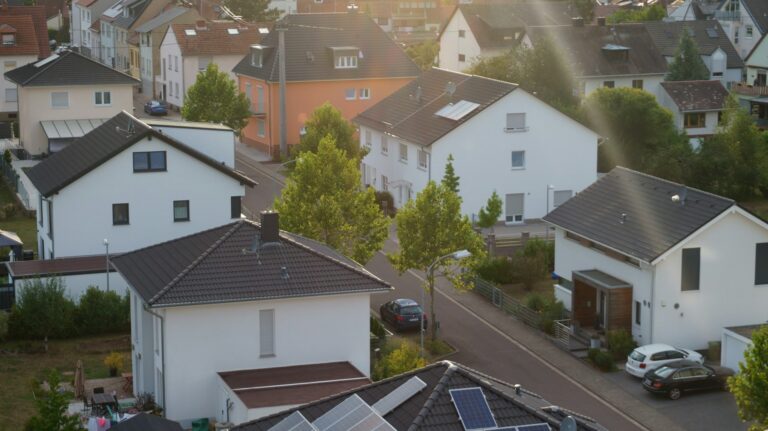
What is set to change for buildings with photovoltaics
The draft abolishes the fixed feed-in tariff for new systems and replaces it with a new marketing form, “grid operator offtake”. The key points for real estate:
Market premium only from 25 kW. New systems below this threshold will in principle no longer receive EEG support for electricity fed into the grid (§ 20 (1) EEG 2027 draft).
A time-limited transitional payment instead of permanent support. Smaller new systems may receive a transitional payment – but only for 36 calendar months after commissioning and at 1 ct/kWh below the applicable value. Eligibility is staggered by year of commissioning: 2027 up to below 50 kW, 2028 up to below 25 kW, 2029 and 2030 up to below 7 kW. From the 2031 commissioning year it ceases entirely. In addition, a direct marketing bonus of 1.5 ct/kWh is envisaged for four years.
Permanent output limitation. The point with the greatest consequences from a valuation perspective is not in the support section: solar installations on, attached to or in buildings with an installed capacity below 100 kW are to limit active power feed-in at the grid connection point permanently to 50 per cent of installed capacity – irrespective of whether a smart metering system is installed and irrespective of the marketing form (§ 9 (2b) EEG 2027 draft). This is not a question of support but a physical capping of yield. Without battery storage, a substantial part of midday generation is lost.
Existing systems remain protected. Systems commissioned by 31 December 2026 retain their guaranteed remuneration for the full 20-year term. This makes 31 December 2026 a hard dividing line: two technically identical systems may in future contribute markedly different amounts of value, solely depending on the commissioning date.
Tenant electricity remains. The tenant electricity surcharge is retained – expressly including new systems below 25 kW. For apartment buildings with supply models, an eligible income component therefore remains available.
Wind energy: the lease cap hits the landowner
For owners of agricultural land, § 36d of the draft is the central provision. It caps the payments operators may make for the use of land to erect and operate onshore wind turbines – at 3.5 per cent of the product of the annual achievable site yield and the applicable value.
It covers not only the turbine site but also payments for ancillary facilities within a radius of 2,500 metres around the tower centre, including compensation for cable routes, as well as payments for setback areas under building regulations. Advance payments are notionally spread over 20 years; chain lease arrangements are expressly included.
Important for classification: according to the explanatory memorandum, the provision is neither a statutory prohibition nor a condition of support – existing contracts remain valid and are not automatically adjusted. Exceeding the cap is sanctioned solely through a payment obligation of the operator to the grid operator amounting to 50 euros per kilowatt of installed capacity and calendar year.
The effect therefore does not operate through the validity of contracts but through the market: no operator will bid above the cap in future. The explanatory memorandum itself assumes that the saving will be passed through almost entirely into lower auction awards, and puts it at an average of 0.19 ct/kWh, or around 453 million euros by 2032.
Existing projects are not affected. The cap does not apply to installations whose award stems from an auction round before 1 January 2028, nor to citizens' energy companies up to 18 MW, nor to installations whose operators forgo support. For sites that can sustain unsubsidised direct marketing, the payment potential therefore remains intact.
Ground-mounted photovoltaics on arable land
For ground-mounted installations on agricultural land that are not subject to auction, the payment claim may fall to zero if the Federal Network Agency has announced at least one month before commissioning that no bids may be submitted for this segment. The support claim therefore depends on an administrative announcement at short notice – for option areas and land held in expectation of development, a risk that can properly be modelled only as a scenario, not as a blanket addition or deduction.
The methodology for valuing solar park land is shown in the article market value appraisal of ground-mounted photovoltaics.
What is in the grid connection package – and not in the EEG
Two legislative projects are currently often conflated. The much-discussed curtailment without compensation in grid-congested areas, system-serving connection capacity and possible construction cost subsidies are not in the EEG draft but in the parallel draft amending energy industry law. For the valuation of wind and solar parks, both projects must be considered together; for the valuation of residential and commercial property, the EEG is essentially the relevant instrument.
The further path through the legislative process
Following the cabinet decision, the following steps are to be expected:
1. First reading in the Bundesrat. The government draft is first submitted to the Bundesrat, which under Art. 76 (2) of the Basic Law generally has six weeks to comment. The Federal Government then forwards the draft, together with its counterstatement, to the Bundestag. In contentious energy-policy matters, such comments typically contain extensive amendment requests from the Länder – particularly from the northern German wind states and the southern German rural states.
2. Deliberation in the Bundestag from the autumn. Because of the forthcoming summer recess, a first reading is not to be expected before September 2026. The Committee on Economic Affairs and Energy will lead the deliberations; a public expert hearing is the rule for a project of this significance. Only the committee's recommendation will show which text is actually put to the vote.
3. Competing draft. On 7 July 2026 the Bündnis 90/Die Grünen parliamentary group introduced its own EEG bill (BT-Drs. 21/6914), which is likely to be considered alongside it. It takes up points required for state aid approval.
4. Second and third readings, then the Bundesrat again. EEG amendments have in the past regularly not required Bundesrat consent; the Bundesrat may, however, call the Mediation Committee. Whether it does so depends largely on the outcome of the first reading.
5. State aid approval by the European Commission. Central support provisions are subject to this reservation. This is no formality: the Commission reviews the support scheme independently, and adjustments during the approval procedure have occurred several times with earlier EEG amendments.
6. Time pressure. The existing EU approval of the EEG support scheme expires on 31 December 2026. The Federal Government is therefore aiming to complete the process by the end of 2026. If that deadline is missed, a scenario arises that corresponds to neither the old nor the new legal position – with corresponding uncertainty for every investment decision aimed at commissioning in 2027.
In short: the text now available is the starting point of the parliamentary deliberations, not their result. Changes to the thresholds for small photovoltaic systems, to the lease cap and to the skimming mechanism are considered likely.
What this means for valuations
Four consequences arise for practice:
The commissioning date becomes a data item to be recorded. In every property inspection involving a photovoltaic system, the commissioning date, installed capacity, remuneration rate and remaining term must be documented. Without these details the contribution to value can no longer be substantiated.
Grandfathered advantages are time-limited, not permanent. A remuneration claim with a remaining term is a time-limited income advantage, not a permanent income component. This applies in particular to the mortgage lending value, which is based on sustainably achievable income.
New systems are to be valued via own consumption. Where feed-in revenue ceases to serve as a calculation basis, avoided electricity purchases take its place – modelled together with storage and the output limitation, not as a blanket addition.
Comparable data ages faster than usual. Purchase price databases, property yield rates and lease comparables reflect contracts concluded under the previous legal position. For land with wind use potential, that data basis is only of limited suitability for new contracts concluded after entry into force. This belongs transparently in the derivation – particularly in court and mortgage lending appraisal reports.
Conclusion
The EEG amendment shifts risk from the support system to the plant operator and the landowner. For existing properties little changes for now; for new investments and for land with wind use potential, the basis of calculation changes fundamentally. In valuation terms, as at today's valuation date the draft is to be presented as a market risk, not as a legal basis.
We are monitoring the process continuously and will adjust our valuation approaches as soon as reliable decisions are in place.
How market value is derived in an individual case is set out on the service page for the market value report.
Do you need a market value appraisal for a property with a photovoltaic system, or for land with a wind or solar use agreement? Get in touch – we provide valuations in the Munich and Erding region for private individuals, companies, banks and courts.
As at 30 July 2026. This article reflects the status of the legislative process as at that date and does not replace legal or tax advice.
Please note: the content of this article is provided for general information only and does not constitute legal, tax, financial or investment advice. It is not a substitute for individual advice from a licensed lawyer, tax adviser or financial adviser. Despite careful research, we accept no liability for the accuracy, completeness or currency of the information provided. For specific legal or tax questions, please consult a qualified professional adviser.