



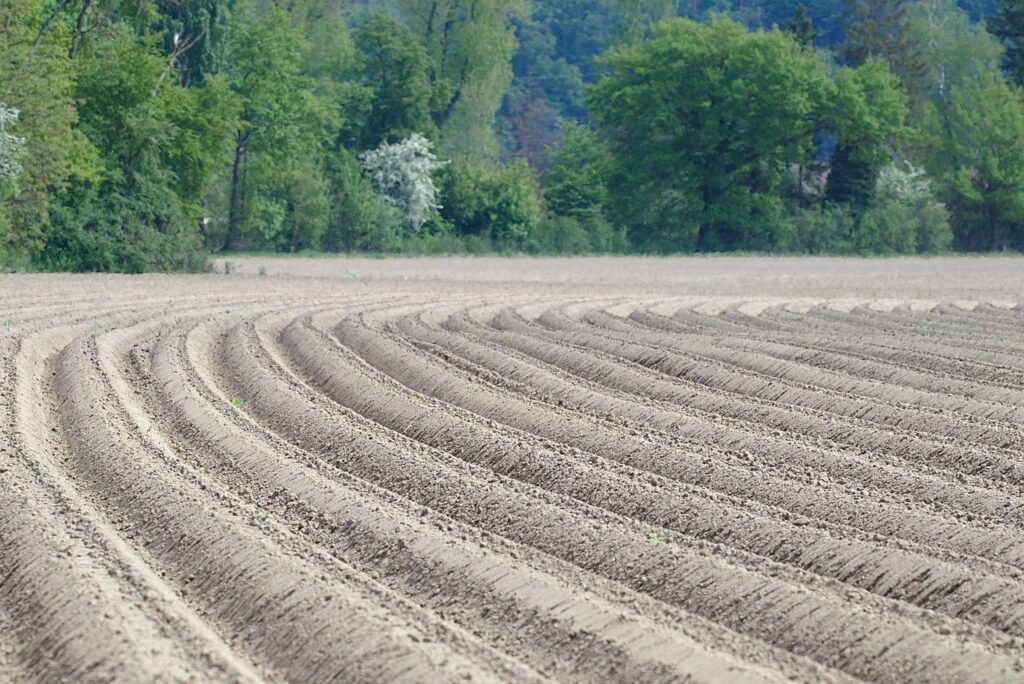
Agricultural land and farms are subject to specific valuation rules: Their value depends less on location and year of construction than on soil quality, income-generating potential, leasehold structures, and possible future use. Anyone who wants to value agricultural land therefore requires an appraisal report that understands agricultural use as well as land law.
The key point
With agricultural properties, what matters is not the residential location but the earning power of the soil and the prospects for use. A hectare of arable land, a tenanted farm business and a farmstead with development potential are valued by entirely different standards – and frequently side by side within a single appraisal report.
What determines the value of agricultural land
The market for agricultural land varies enormously from region to region. Between a hectare of arable land in an area with high livestock density and biogas demand and a comparable plot in a structurally weak location, purchase prices often differ by multiples, not percentages. Four factors carry the value.
First, the soil quality, measured by the indicators of the official soil survey. Second, the workability: field size, layout, gradient, access via made-up farm tracks and the distance to the farmstead determine the use of machinery and thus the achievable gross margin. Third, the regional demand, which is driven less by earning power than by competition for land – expanding livestock finishing operations, biogas plants and non-agricultural investors push prices in individual districts far above the agricultural income level. Fourth, existing leasehold arrangements: land let on a long lease is valued differently from land that can be farmed by the owner straight away.
Soil survey: arable rating, grassland rating and yield measurement figure
The official soil survey assesses every plot by soil type, condition class and origin. From this follows the soil rating and – after additions and deductions for climate and terrain – the arable rating or grassland rating on a scale up to 100. Multiplied by the area, this gives the yield measurement figure (EMZ), which serves as the yardstick for comparing plots and is regularly used as the reference unit in the purchase price databases of the valuation expert committees.
For the valuation, the soil survey is therefore the key to comparability: only the price per yield point makes purchase prices for differing soil qualities comparable. The data are available through the tax offices and the land registers; how current they are should be checked and stated in the report, because soil survey results sometimes date from assessments carried out decades ago.
The appropriate valuation methods
The basis for determining market value here too is the ImmoWertV. Which method takes the lead depends on the object being valued.
| Valuation subject | Leading method | Notes |
|---|---|---|
| Undeveloped arable and grassland | sales comparison approach | First choice, provided the purchase price database contains enough cases of comparable soil quality; conversion via the yield measurement figure |
| Entire farm businesses and income-oriented land | Income approach | The sustainably achievable net income or the rent determines the value; the capitalisation rate is to be derived from the regional agricultural market |
| Farm buildings, livestock housing, farmstead | Cost approach | No comparable market available; economic depreciation from overcapacity and outdated husbandry technology must be examined separately |
| Land with development potential or energy use | Adjusted comparable value, supplemented by a residual analysis | Determine the development status under section 3 ImmoWertV; reflect the waiting period and the risk of realisation |
A separate set of rules applies for tax purposes: the valuation of agricultural and forestry assets for inheritance tax, gift tax and property tax follows sections 158 et seq. of the Valuation Act, with a heavily standardised income approach, a minimum value and – where the property is sold or its use changed within the retention period – the liquidation value under section 166 of the Valuation Act. Because these standardised values can deviate considerably from the market value, proving a lower common value under section 198 of the Valuation Act by means of a market value appraisal is often the economically decisive step.
Farm tenancies: term, level and legal framework
With agricultural land, the tenancy is no side issue but regularly the value-determining contract. Three points need to be clarified for the valuation.
First, the remaining term: a buyer who wants to farm the land himself cannot use a plot tied up for years – the value approaches that of a pure investment property. Next, the ratio of contractual rent to the local market rent: older tenancy agreements are often well below today's market level, which creates a lasting income disadvantage that must be reflected in the income value. Finally, the contract terms – index-linking clauses, extension options, provisions on successor tenants and on the allocation of public charges.
In legal terms, note that farm tenancy agreements must be notified to the competent authority under the Agricultural Tenancies Act and may be objected to. When valuing a business with a high proportion of tenanted land, the report must also address how stable that land base is: a business whose tenancy agreements largely expire in the short term carries a structural risk that has to be reflected in the capitalisation rate.
Separating farmstead, residential part and business assets cleanly
A farm business is rarely a single unit. What frequently has to be valued separately is the agricultural land, the farmstead with its farm buildings, a private residential part, and both livestock and machinery.
The farmstead raises questions of its own: older livestock buildings often no longer meet today's animal welfare and emissions requirements, so they exist physically but have lost their economic value. A valuation that applies only construction costs less depreciation for age to such buildings regularly overstates the value. Conversely, a farmstead in the outlying area may hold considerable hidden reserves where a change of use is legally possible under section 35 (4) of the Federal Building Code – the privileged conversion of former agricultural buildings for residential use.
The residential part follows the general rules for developed properties and has to be recorded separately for tax purposes in any case. When a farm is handed over, the distinction between the residential and the business part determines which tax relief provisions apply.
Rights, restrictions and payment entitlements
Not everything that makes up the value of a farm business appears in the land register. The following in particular must be recorded and distinguished:
- Public law restrictions – water protection zones with farming restrictions, flood plains, Natura 2000 sites, conservation agreements and compensation areas permanently reduce the intensity of use.
- Easements and wayleaves – rights of way, access rights and wayleaves, increasingly also routes for underground cables and access roads for wind turbines, either reduce value or generate income depending on how they are drafted.
- Milk delivery rights and supply agreements – no longer tradable quotas today, but still contractual ties to dairies and producer groups that affect the income position.
- Direct payments under the Common Agricultural Policy – the CAP reform of 2023 abolished the previously tradable payment entitlements; direct payments have since been granted purely on an area basis and are tied to compliance with conditionality and to eco-schemes. There is no longer any separately tradable asset in this respect – older appraisal reports that still show payment entitlements as a separate item are out of date.
- Hunting and fishing rights as well as shares in common land and cooperatives.
Special case of development potential: when arable land becomes building land
Particularly relevant to value is the question of whether land remains in permanent agricultural use or whether a development potential exists. Section 3 ImmoWertV distinguishes four development stages: agricultural and forestry land, expected building land, raw building land and land ready for development. Between the first and the last stage there is regularly a multiple in value.
What matters is that, on the facts, the expectation of development must be sufficiently certain – mere hope is not enough. The touchstones are the designation in the land use plan, resolutions to draw up a development plan, the municipality's settlement growth and the state of servicing. Two figures have to be substantiated for the valuation: the degree of probability and the expected waiting period until the land is ready for development, over which the future building land value has to be discounted. An appraisal report that shows a development potential premium without this derivation will not withstand scrutiny by the tax office or a court.
Note also the Land Transactions Act: the sale of agricultural land generally requires official approval, which may be refused where it would result in an unsound distribution of land; alongside this there is a statutory pre-emption right for rural resettlement purposes. In some regions this approval practice narrows the circle of potential buyers and thus affects the price level.
Renewable energy on agricultural land
Letting land for photovoltaic or wind energy installations creates long-term cash flows that have little in common with agricultural use. The value of such land then no longer follows the yield measurement figure but the use agreement: term, level of payment, indexation, dismantling obligations and securities determine the result. For ground-mounted photovoltaics, questions of eligibility for support and the grid connection situation are added.
Note that the legal framework is currently shifting noticeably – particularly with regard to payments for wind energy sites and support for ground-mounted installations.
For a deeper look: market value appraisal of ground-mounted photovoltaics and EEG amendment 2027: What the government draft means for real estate valuation
Typical valuation occasions
- Sale, purchase and consolidation of land, frequently subject to approval under the Land Transactions Act
- Inheritance and farm succession, including anticipated succession and the special farm inheritance law in those federal states with a Farm Succession Act
- Inheritance and gift tax with proof of a lower common value under section 198 of the Valuation Act
- property tax, mortgage lending and financing of farm businesses
- Settlement of communities of heirs and of marital property, as well as equalisation of accrued gains
- Expropriation and land consolidation, compensation for wayleaves and permanent restrictions on use
Practical note on farm succession
Where a farm is handed over by way of anticipated succession, it pays to have the valuation done before notarisation: only when market value, residential part and business assets are cleanly separated can compulsory share claims, equalisation payments to siblings and the inheritance tax relief provisions for business assets be calculated reliably.
What a robust appraisal report must contain
- the soil survey results for each parcel, with the arable or grassland rating and the yield measurement figure,
- the derivation of the comparable value from the purchase price database of the competent valuation expert committee, converted to the soil quality of the property being valued,
- a complete schedule of tenancies with terms, payments and a comparison with the local market rent,
- the separate presentation of land, farmstead, residential part and inventory,
- a schedule of the rights and restrictions with their respective effect on value,
- where development potential is assumed, the substantiation of probability and waiting period instead of a flat-rate premium.
Conclusion
Valuing agricultural land and farm businesses means looking at soil quality, earning power, tenancies and prospects for use together – and separating farmstead, residential part and rights cleanly. What makes this asset class distinctive is that three levels of value exist side by side: the agricultural income value, the market price driven by competition for land, and the prospect of a different future use.
A robust market value appraisal makes transparent which part of the value rests on the substance, which on the income and which on a possible future use – and thus provides the basis that holds up before the tax office, the courts and the bank.
Answered briefly in our questions and answers: How is an agriculturally used property valued? and How is an agricultural and forestry business valued in the event of inheritance?
For evidence that holds up before the tax office, a court or a bank, what is needed is a market value report.
If an energy facility is located on the site, the valuation basis shifts entirely. How to calculate this in this case is addressed in the article on wind turbines and wind farm sites.
Please note: the content of this article is provided for general information only and does not constitute legal, tax, financial or investment advice. It is not a substitute for individual advice from a licensed lawyer, tax adviser or financial adviser. Despite careful research, we accept no liability for the accuracy, completeness or currency of the information provided. For specific legal or tax questions, please consult a qualified professional adviser.