
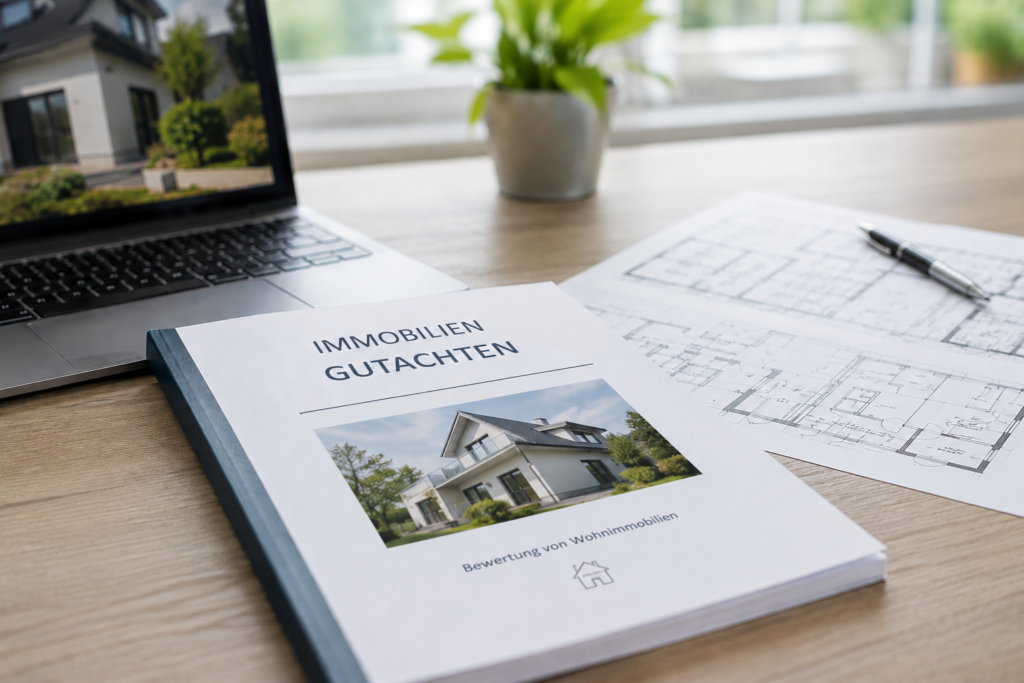
You need a reliable valuation for a property in Starnberg? I prepare market value appraisals in accordance with § 194 BauGB and the ImmoWertV guidelines, condensed appraisal reports for private use, as well as appraisals covering remaining useful life, rental value, and mortgage lending value.
Starnberg is located approximately 25 kilometers southwest of Munich on the northern shore of Lake Starnberg. The S-Bahn line S6 connects the city to the state capital, while the A95 motorway to Garmisch-Partenkirchen passes to the east. Proximity to Munich and lakeside location converge here — the combination that explains the price level.
Starnberg is among the most expensive residential areas in Bavaria, and the price variation within the city is considerable. There is a world of difference between a property with a lake view, a location in Söcking, and a terraced house in the north — not only in price, but in the derivation process. Waterfront locations cannot be captured solely by the standard land value; here, plot shape, access to the shore, slope gradient, and what the building regulations actually permit are decisive.
Additionally, the proximity to Munich plays a key role: The S6 railway line provides direct connectivity to Starnberg, broadening the market compared to similar lakeside municipalities. For an appraisal report, this means clearly distinguishing between second-home demand and commuter market demand.
Market structure
The basis for any valuation is the data from the competent expert committee (Gutachterausschuss). The Expert committee (Gutachterausschuss) for Land Values of the District of Starnberg pursuant to § 195 BauGB, conducts the collection of purchase prices, derives the standard land values from this data, and publishes the real estate market report containing transaction figures, price trends, and the required data — including property yield rates, cost approach factors, and comparison factors. Standard land values, the purchase price collection, and the real estate market report are exclusively available from the committee itself.
These data apply exclusively to the area of the respective committee. This is why a value cannot be derived from a neighboring district: a different purchase price database, a different property yield rate, and a different valuation date apply there. Relying on nationwide average values misses the mark entirely.
Location and submarkets in Starnberg
The location of the property within the municipality can be traced on the map.
Adjacent areas
The data basis ends at the jurisdictional boundary — beyond it, a different expert committee, a different purchase price database, and separate standard land values apply. For properties in the vicinity, you can find the responsible authority here:
Regarding the standard land values: The expert committee (Gutachterausschuss) of the Starnberg district does not make its standard land values available via the central Bavarian mapping service. You can obtain information directly from the expert committee; for valuation purposes, I retrieve them there, supplemented by my own analyses of the local market.
Which approach is appropriate here?
In the larger municipalities, the collection of purchase prices is sufficient for the sales comparison approach; in smaller municipalities, there are often too few sales transactions per year for the Cost approach for single- and two-family homes represents the more viable approach. For rented properties and mixed-use buildings, this Income approach decisive. The choice of valuation method must be justified in the appraisal report — not the other way around.
Which appraisal report do you need?
This is essential for the tax office, courts, and banks. market value report the correct format. If the matter concerns a private decision — sale price, inheritance settlement, or renovation — a condensed appraisal report is often sufficient. short-form appraisal at a fixed price. For a higher depreciation, the Remaining useful life appraisal report consider, for rent levels and rent increases, the Rental value appraisal.
The location in numbers
Starnberg is part of the district of Starnberg, which comprises a total of 139,067 residents across 15 municipalities. The expert committee (Gutachterausschuss) of the district, not the city itself, is responsible for standard land values; the purchase price register is maintained at the district level. The map above illustrates the relative positions of the municipalities within the district.