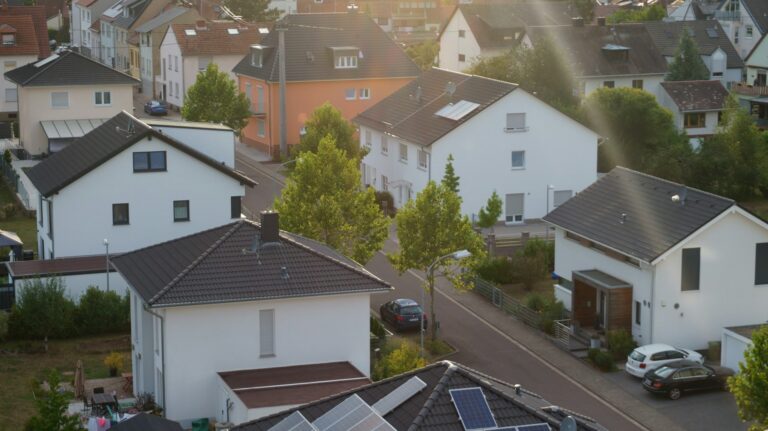
Buying an older house: correctly assessing value, renovation costs and GEG obligations
How to assess the market value, renovation backlog, and new GEG obligations before purchasing – before your budget is exceeded.
Read morePlease accept the cookie settings first so this section works.
Personal video meeting via Microsoft Teams – book your preferred slot now.
Phone consultation – conveniently pick your preferred slot.
Professional valuation – fast, discreet and court-standard.
General inquiry via our contact form.
Please accept the cookie settings first so this form works.
Non-binding orientation aid and not tax advice
A remaining useful life report can increase your annual depreciation (AfA) and so lower your tax burden in the following years. Calculate here how a shorter remaining useful life can compare with statutory depreciation. Total depreciation stays the same; it is brought forward.
All information provided without guarantee. This calculator serves as non-binding orientation and does not replace tax advice.
| Year | Statutory depreciation | Statutory book value | AfA appraisal report | Book value per appraisal report | Cumulative head start |
|---|---|---|---|---|---|
| Enter your details … | |||||
* For an earlier purchase: the statutory depreciation claimed up to the end of the previous year (year of acquisition pro rata, Section 7 (1) sentence 4 EStG) is deducted from the building value. Both columns start from the remaining residual value; the appraisal-based depreciation spreads it from the current year over the remaining useful life determined by the valuer (Section 7 (4) sentence 2 EStG). As the useful life starts on acquisition (Section 11c (1) sentence 2 no. 3 EStDV), there is only an advantage if the RUL is below the remaining statutory useful life.
The AfA (depreciation for wear and tear) spreads the acquisition or construction costs of the building over its useful life; the annual amount reduces your rental income as an income-related expense (Section 7 (4), Section 9 (1) sentence 3 no. 7 EStG). Under Section 7 (4) sentence 1 EStG, straight-line depreciation is 2% of the building value per year (completion 1925–2022), 2.5 % for completion before 1925 (40 years) and 3 % for completion from 2023 (33 years). This reduces your taxable income over the entire depreciation period.
Section 7 (4) sentence 2 EStG (German Income Tax Act) permits a higher depreciation rate if the actual remaining useful life of your building is demonstrably shorter than the statutory standard useful life (50, 40 or 33 years). An expert appraisal report can provide this proof. You may use any method of demonstration suitable for the individual case; a building fabric survey is not required, and the tax office and fiscal court assess the report (Federal Fiscal Court, 28 July 2021 – IX R 25/19). A report based on the ImmoWertV can also suffice if it is substantiated for the specific property (Federal Fiscal Court, 23 January 2024 – IX R 14/23; Fiscal Court of Münster, 2 April 2025 – 14 K 654/23 E); a mere reference to the ImmoWertV model values is not enough. The tax authorities revoked the stricter requirements of the Federal Ministry of Finance letter of 22 February 2023 with its letter of 1 December 2025. The shorter the remaining useful life determined by the valuer, the higher the individual depreciation rate: For an RND of 25 years, for example, 4 % instead of 2 % p. a. (100 % ÷ 25 years).
Not the entire purchase price is depreciable. The tax office distinguishes between two portions:
The land share depends heavily on the location: rural areas typically 5–15 %, suburbs 15–25 %, cities 25–40 %, inner-city locations 40–60 %, prime locations up to 80 %. The allocation is based on the ratio of the market values of the land and the building (BFH v. 10.10,2000 – IX R 86/97). Our calculator automatically determines your personal depreciation base from this.
The cost depends on the property; after the free preliminary check you receive a binding fixed fee. For let properties, appraisal fees are usually deductible as income-related expenses (Section 9 (1) sentence 1 EStG). The calculator shows after how long the additional annual relief covers the appraisal costs you entered – a model calculation, not a promise.
The potential is typically greatest for:
For newer buildings (built after 2000) and low purchase prices, the effect is often small. Buildings completed from 2023 already get the statutory rate of 3 % (33 years); if construction started from October 2023, declining-balance depreciation under Section 7 (5a) EStG may also be an option.
A report only has an effect if the remaining useful life is below the statutory useful life (Section 7 (4) sentence 2 EStG). For residential buildings, the ImmoWertV assumes a model total useful life of 80 years (Annex 1 ImmoWertV); without modernisation, the remaining useful life therefore only falls below 50 years from a building age of around 30 years .
Modernisation extends the remaining useful life (Section 4 (3) in conjunction with Annex 2 ImmoWertV) and pushes the threshold upwards; after a full refurbishment a report is usually not an option. The additional annual depreciation is building value × (1/RUL − 1/50): with a building share of EUR 300,000 and an RUL of 30 years, that is around EUR 4,000 more depreciation per year; with an RUL of 45 years, only around EUR 670.

Exactly as long as the remaining useful life determined in the appraisal report lasts. If the remaining useful life according to the appraisal report is, for example, 28 years and the tax office accepts it, you can apply the higher depreciation rate for 28 years — after that the building value is fully written off for tax purposes. The remaining useful life determined by the valuer is proven to the tax office once and used as the basis for depreciation in the following years. For an earlier purchase, the residual value not yet written off is spread over the remaining useful life (Section 7 (4) sentence 2 EStG; useful life starts on acquisition, Section 11c (1) sentence 2 no. 3 EStDV). The result is a deferral or liquidity effect: total depreciation stays the same, it is just claimed earlier. If the property is sold within ten years, the additional depreciation increases the taxable capital gain because it reduces the acquisition costs (Section 23 (1) sentence 1 no. 1, (3) sentence 4 EStG).
No. The calculator serves exclusively for non-binding orientation. It does not calculate a legally binding depreciation basis and does not take individual tax circumstances into account. All information without guarantee. For your tax decision we recommend advice from a tax adviser and an expert report under Section 7 (4) sentence 2 EStG by a suitably qualified valuer.
Request a preliminary check now
How to assess the market value, renovation backlog, and new GEG obligations before purchasing – before your budget is exceeded.
Read moreBriefly describe your request to us. We will respond within one business day with a concrete offer — free of charge and without obligation.