

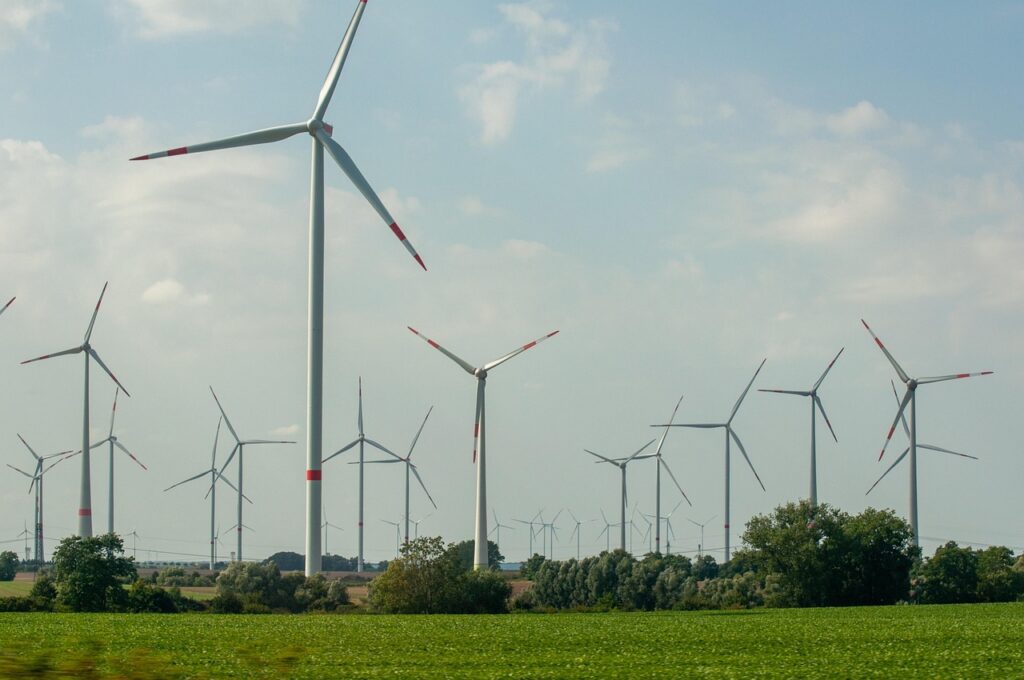
Two hectares of agricultural land in the outer area, standard land value of eight euros per square meter. A wind turbine stands on the site, and the owner receives an annual usage fee that exceeds the land value of the entire area by many times. Anyone who applies the standard land value here misses the market value not by a few percentage points, but by orders of magnitude.
Valuing wind turbines and wind park sites therefore first requires clear separation. What is being valued is not the wind or the company, but a plot of land whose earning capacity stems from an air pollution control permit and a long-term contractual framework.
The key point
The value driver is not the floor area, but the site-specific approval and the usage fee linked to it. The installation itself is operating equipment and not part of the land; its revenues belong to the company, not to the real estate assets.
Three levels that must not be conflated
Before capitalising a single cash flow, it must be clarified what exactly is the subject of the valuation. There are three levels with entirely different valuation standards.
- The property – the site, setback, and access areas, including the encumbrances attached to them. Under Section 194 of the Building Code (BauGB), this is precisely the subject matter of the market value.
- The facility – The tower, foundation, gondola, and rotor are operating equipment; they typically remain the property of the operator and do not form part of the real estate assets.
- The project company – Approvals, feed-in or off-take agreements, financing, and operational management. Their value constitutes a business valuation, not a real estate valuation.
An appraisal report that mixes these levels becomes unusable for any purpose: for inheritance tax, for financing, and especially for a purchase contract.
The land use roles within the wind farm
A wind park requires significantly more land than the site itself, and each role is compensated differently.
-
Site area
- Foundation, crane working area, and assembly area, approximately half a hectare per installation
- Carries the main remuneration, usually as a share of the electricity revenues with an agreed minimum payment
- During operation, not usable for agricultural purposes
-
Setback and overflight areas
- Adjacent properties where setback areas or the rotor sweep must be tolerated
- Secured by a planning commitment (Baulast) and a limited personal easement
- The tolerance is compensated separately and reduces the developability of the affected area
-
Access
- Heavy-load-capable access roads for construction, maintenance, and subsequent decommissioning
- Permanent encumbrance, often with expansion obligations and maintenance provisions
- For the valuation, an independent item, usually underestimated
-
Cable route
- Connection to the substation, often spanning several kilometers and multiple property owners
- One-time compensation or ongoing remuneration, secured via easement
- Rank position in the land register must be checked, as it affects the lending capacity
-
Compensation areas
- Nature conservation compensation, permanently fixed in the use
- The binding is plot-specific and outlasts the operation of the facility
- Value-reducing, provided they are not offset by a running fee
The value driver: usage fee and earnings forecast
The remuneration for the site area is generally agreed as a share of the electricity revenues, secured by a minimum rent. In some contracts, participation by neighbors or the host municipality is also included. For valuation purposes, five points are decisive:
- Earnings forecast for the site – Wind energy reports indicate the expected annual yield with exceedance probabilities. For a prudent valuation, the conservative value should be used, not the expected value.
- Revenue side – premium from the EEG tender, direct marketing, or a long-term power purchase agreement. The remaining term of the secured remuneration is the actual turning point in the cash flow.
- Lease term – twenty years is standard, with extension options held by the operator. The end of remuneration and the end of the usage contract rarely coincide.
- Adaptation clauses – Indexation, compensation upon repowering, and provisions for the event of an operator change.
- Collateral – ranking position of the easement, dismantling guarantee, and the question of whether the contractual partner is a pure project company.
For the land area itself, this results in an income value derived from capitalised usage fees over the secured term, supplemented by the residual value of the land after decommissioning. The same structure is used for the contribution to the market value appraisal of ground-mounted photovoltaics, but with significantly larger land requirements and lower remuneration per hectare.
A common mistake
The ongoing usage fee is capitalised as a perpetuity. In reality, the cash flow ends with the contract term, and what follows depends on repowering, the permit status, and the market price. Without this cutoff, a value is generated that no buyer would pay.
The approval as the actual economic asset
Wind turbines with a total height of more than 50 metres require approval under the Federal Immission Control Act. This approval is facility- and site-specific; it transfers to the legal successor upon a change of operator—and it is the actual bottleneck in the market. Sites eligible for approval are scarce because setback regulations, nature conservation, air traffic control, heritage protection, and military interests interact.
At the planning level, wind energy in the outer area is privileged under Section 35(1) No. 5 of the German Building Code (BauGB). The states (Länder) manage the area framework through designations, the scope of which is dictated by the Wind Energy Areas Act (Windenergieflächenbedarfsgesetz) with binding area targets. For valuation purposes, this means: Whether a site lies within or outside a designated wind area is a hard value boundary, not a nuance. Where a permit already exists, the site is a different economic asset than the identical neighboring parcel without a permit.
Demolition, security deposit and the end of the term
Under Section 35(5) of the Building Code (BauGB), the obligation to demolish structures is a prerequisite for approval if the use is permanently discontinued, and the authority should secure compliance through a security deposit. In practice, this entails three points of review:
- If a demolition guarantee has been provided, in what amount and with what adjustment clause?
- Does the demolition also include the foundation and access road, or only the visible parts?
- Who bears the difference if the actual costs exceed the security deposit – the operator or ultimately the landowner?
The third point determines the residual value of the site. If the operator is a special-purpose vehicle with no other assets and the security margin is too narrow, the owner faces a real risk that must be factored into the value.
Repowering: the extension is not a given
During repowering, older installations are replaced by fewer but more powerful units. For the owner, this is the decisive question upon expiry of the initial term, as it determines whether the cash flow continues or ends.
The approval framework has been simplified because the prior burden from existing facilities is taken into account during the review. Nevertheless, repowering is not automatic: larger facilities require greater setbacks, different locations within the site, and a reliable grid connection. For valuation purposes, it is therefore necessary to distinguish between a mere possibility and a procedure already initiated with an application, preliminary approval, or signed supplementary contract. Only the latter is a value-relevant fact; everything else is an expectation – and if anything, it should be discounted.
Which valuation method fits
| Subject matter | scenario | Notes |
|---|---|---|
| Site area with an ongoing lease agreement | Income approach, periodically | Capitalisation over the remaining term, followed by the land value approach after demolition |
| Encumbered neighboring parcel with easement or building obligation | Land value with discount | Discount based on the extent of usage restrictions, offset against the fee |
| Wind park site with permit, prior to construction | Residual value calculation | Approval value as the difference between project value and investment costs |
| Operating company, share transfer, financing | DCF method | Company-specific; must be disclosed separately from the land value |
| Agricultural residual area within the wind farm | sales comparison approach | Consider management difficulties due to access routes and facility locations |
For the agricultural side of the equation – lease, income measurement index, and management difficulties – the article on agricultural land and farms the fundamentals.
Rights, encumbrances and contracts
The contractual security of a wind farm is almost entirely located in Section II of the land register. The type and rank of easements, real burdens for ongoing payments, building obligations for setback areas and access roads, as well as pre-emption rights must be examined. The crucial factor is the rank: If the operator's easement ranks ahead of the bank's mortgage, this significantly changes the realizability of the property.
Equally important is the usage agreement itself. It governs the term, payment structure, transferability, dismantling, and the implications of the operator's insolvency. An appraisal that fails to evaluate this agreement describes a space, not a value.
Typical valuation occasions
- Inheritance and gift – Areas with wind energy installations in the estate, often combined with agricultural assets and subject to considerable dispute potential regarding the valuation approach.
- Purchase and sale – Land acquisition by project developers, sale of encumbered land, and valuation of pre-emption rights.
- Taxation – purchase price allocation, property tax, and the delineation between real estate and operating equipment.
- Financing – Encumbered sites; the ranking position of the easements is the critical point here.
- Settlement – Heirs' community, equalisation of accrued gains, or partition, when a wind turbine stands on the partition mass.
- Compensation – for tolerances, cable routes, and operational burdens.
- Acquisition and follow-up valuation for funds – for special real estate assets under the German Investment Code (KAGB), the consideration may not significantly exceed the value determined by external valuers (§ 231 KAGB). The valuation is carried out by two independent external valuers (§ 249 KAGB), with subsequent revaluation generally occurring within a period of three months (§ 251 KAGB). For special funds in the renewable energy sector, the remaining contract term, demolition security, and permitting status are the critical points.
What a robust appraisal report must contain
- the assignment of the levels of the property, facility, and operating company, expressly and substantiated,
- the usage agreement with fee structure, term, options, and transferability,
- the permit status including ancillary provisions on operating hours, noise quotas, and soundproofing requirements,
- the revenue forecast with specification of the underlying probability of exceedance,
- the dismantling provision with the amount and adjustment of the security deposit,
- the land register status with the rank of easements and real burdens,
- a sensitivity analysis for revenue, electricity price, remaining term, and discount rate.
Conclusion
Valuing wind energy plants and wind park sites means separating a plot of land from an operation and seeking the value where it arises: in the approval, the contract, and the remaining term. The standard land value of the surrounding fields describes the starting position, not the result.
Those who accurately reflect the cutoff at the end of remuneration, identify the demolition risk, and only include repowering if it has been demonstrably initiated, will arrive at a value that can withstand scrutiny by the tax authorities or banks.
How strongly the grid connection and the technical system can determine the value of an area is shown even more clearly by large-scale battery storage systems.
The version of the law to be applied in an appraisal report is determined by the valuation date.
Please note: the content of this article is provided for general information only and does not constitute legal, tax, financial or investment advice. It is not a substitute for individual advice from a licensed lawyer, tax adviser or financial adviser. Despite careful research, we accept no liability for the accuracy, completeness or currency of the information provided. For specific legal or tax questions, please consult a qualified professional adviser.