



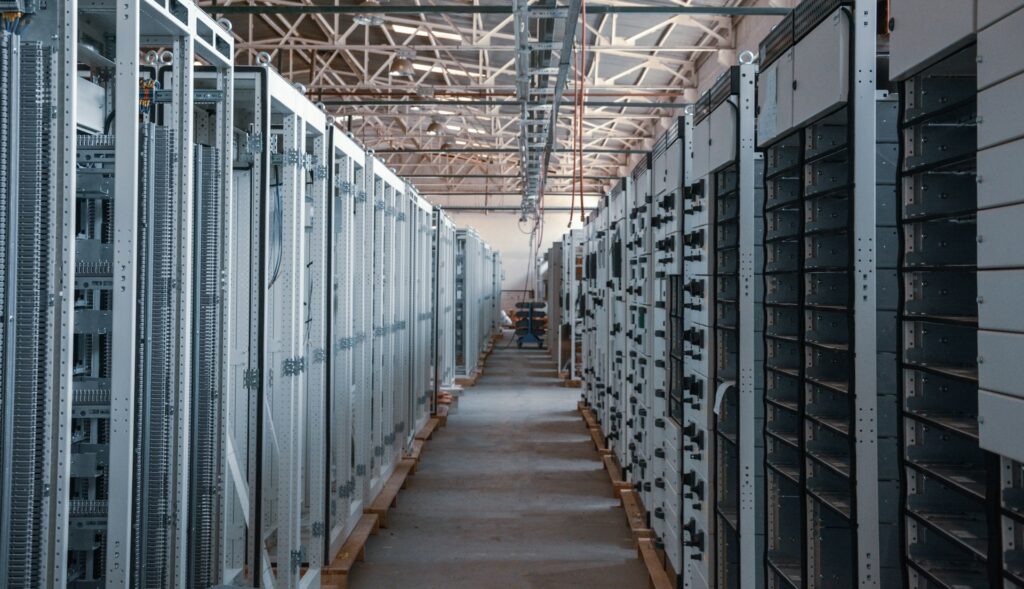
One hectare of grassland, immediately adjacent to a substation. The land has little agricultural value, is located in an outer area under zoning regulations, and is not suitable for residential or commercial use. Nevertheless, a project developer offers an annual remuneration that exceeds the land value within a few years. The reason is not on the plot itself, but two hundred metres away: at the grid interconnection point.
Valuing large-scale battery storage therefore means seeking the value where it is generated. Not in the land area, not in the battery itself, but in the secured access to the grid and in the contract that ties this access to the property.
The key point
The value-determining factor is the connection commitment from the grid operator in conjunction with the planning law compliance. The battery itself is operating equipment, the area fee is the cash flow to be capitalised, and both terminate with the contract term.
Why the grid connection capacity is the actual subject of valuation
A large-scale battery storage system requires little land but significant grid connection capacity. This reverses the conventional logic of land valuation: it is not the plot of land seeking a use, but rather a specific use seeking the one point in the grid where it is permissible and technically feasible.
The connection follows the Energy Industry Act (EnWG). Network operators are obliged to provide a connection but designate the connection point and charge construction cost contributions. Whether capacity is still available at the nearest substation determines the feasibility of the entire project – and in many network areas, waiting lists exist. For valuation purposes, this establishes a clear hierarchy of documents: A binding connection commitment with a specified connection point, confirmed capacity, and deadlines constitutes a fact. An inquiry is not.
It is crucial to correctly assign the legal nature: The connection commitment is legally tied to the operator’s application for connection, not to the property itself. It becomes relevant to the owner’s valuation only through the usage agreement – and due to the simple fact that an alternative site in close proximity usually does not exist.
Site types and their valuation logic
-
Standalone at the substation
- Independent storage facility in close proximity to the substation, capacity in the double-digit megawatt range
- Highest space remuneration, because suitable locations are extremely scarce
- The most demanding case under planning law, see below
-
Co-location with photovoltaics
- Storage facility at an existing solar park, shared use of the connection and substation
- The remuneration is in addition to the existing land lease; lease terms must be synchronized
- Must be contractually clearly separated from the solar lease agreement
-
Co-location with wind energy
- storage in the wind farm, often at the existing connection point
- Additional burden on already encumbered land; easements must be adjusted
- Dismantling and liability provisions of the legacy contracts rarely apply automatically
-
Industrial and commercial sites
- Storage behind the grid connection of a business, for peak load shaving and self-supply
- Generally unproblematic from a planning law perspective, as it is permissible in commercial or industrial zones
- The benefit lies in avoided costs and should be valued accordingly
Building permit: the first and most critical step
For a long time, the planning law permissibility of storage facilities in the outer area was the bottleneck, as there was no independent privilege and every project required a zoning plan. The legislator has responded: With the Bundestag resolutions of November 13 and December 4, 2025, battery storage facilities were included as privileged projects in § 35 paragraph 1 BauGB, in two categories – storage in a spatial-functional connection with an existing renewable energy generation facility, and independent storage with a minimum capacity of four megawatts, located within a specified distance to a substation or power plant and adhering to certain area limits.
This development is significant for the valuation in two respects. Firstly, a privilege substantially shifts the value because it saves the land-use planning procedure and thus years of lead time and dependence on a municipal council resolution. Secondly, the prerequisites are highly detailed and had already been amended within a few weeks. Therefore, the current status is always decisive as of the valuation date current version, checked at the specific site – distance, capacity, area size, and the share of the municipal area must be demonstrated individually.
A common mistake
The market value is directly derived from the required site fee. However, offers from developers are often submitted before the clarification of grid connection and building permits, and are subject to corresponding reservations. Without a connection commitment and a planning law basis, one appraises a letter of intent.
The value driver: area charge and its derivation
The owner's cash flow consists of the remuneration for space and rights. Five factors determine it:
- Reference size – Fees are agreed per hectare, per megawatt of grid connection capacity, or as a combination. The reference unit determines how a subsequent increase in capacity affects the fees.
- term – typical terms are twenty to thirty years with extension options in favor of the operator. The technical service life of the battery is shorter, and replacement within the contract period is planned.
- Security and indexing – Value preservation clause, minimum remuneration, and the question of whether payments are made during the construction and approval phase.
- Ancillary areas – Access roads, transformer stations, cable routes, and fire water retention require additional land and are frequently compensated separately.
- demolition – Amount, adjustment, and value retention of the dismantling security; the disposal of large quantities of batteries is not a minor item.
Reliable comparable values from purchase transactions are rarely available for this emerging use. The land value must therefore typically be derived from the contractual remuneration – capitalised over the secured term, supplemented by the land value after demolition, and reduced by the risk that the project may fail before realisation. Methodologically, this corresponds to the approach used for open-space photovoltaics, albeit with a significantly higher fee per hectare and a shorter track record.
Which valuation method fits
| for the | scenario | Notes |
|---|---|---|
| Space with concluded use agreement and connection commitment | Income approach, periodically | Capitalisation over the secured term, followed by land value after dismantling |
| Land with preliminary contract or option, approval pending | Land value plus expectation value | Disclose realisation probability; do not apply full credit to the fee |
| Project rights, share sale, financing | DCF method | To be disclosed separately from the property value on a company-specific basis |
| Storage as part of a commercial operation | Cost approach for the property | Storage as operating equipment separately; operationalise benefits from peak load shaving |
In all cases, the same separation applies as with other energy facilities: batteries, inverters, transformers, and control technology are operating equipment and, according to § 68 paragraph 2 sentence 1 number 2 BewG, do not belong to the real property. The property includes the land, infrastructure, access routes, and buildings in the narrower sense.
Risks to be included in the interest rate
The revenue side of a storage operator derives from multiple sources – ancillary services, trading on electricity markets, avoided grid charges, and capacity provision. These revenue streams are volatile and subject to regulatory influence. For the valuation of the property, this is only indirectly relevant, but it determines whether the contracting party can sustain the payment of the remuneration over the long term.
Particularly noteworthy are:
- Regulatory risk – The fee structure, exemption provisions, and funding conditions change faster than the contract term.
- Technology risk – cell degradation, replacement cycles, and the question of who finances the replacement.
- Fire protection and setbacks – Firewater retention, setback distances between containers, and emergency provisions may subsequently increase the site requirement.
- Creditworthiness of the operator – Project companies without parent guarantees are the rule, not the exception.
- Priority position – the operator's easement often takes priority over the bank's mortgage charge, thereby affecting the property's mortgageability.
Typical valuation occasions
- Purchase and sale – land acquisition by project developers, sale of already committed land parcels, valuation of option contracts.
- Inheritance and gift – Storage areas in the estate, often in connection with agricultural assets.
- Financing – mortgage lending of the space and review of the ranking of encumbrances.
- Taxation – purchase price allocation, property tax, and the demarcation between real assets and operating equipment.
- Municipal Valuation Occasions – Sale or lease of municipal-owned land and proof of a market-conforming remuneration.
- Project development – Feasibility study and project cost calculation prior to the acquisition of the property.
- Acquisition and follow-up valuation for funds – for real estate special assets under the German Investment Code (KAGB), the consideration may not significantly exceed the value determined by external valuers (§ 231 KAGB). The valuation is carried out by two independent external valuers (§ 249 KAGB), and the revaluation is, in principle, conducted within a period of three months (§ 251 KAGB). For infrastructure and energy funds, the connection commitment and the stage of realisation are of primary importance.
What a robust appraisal report must contain
- the status of the grid connection with linking point, committed capacity, deadlines, and construction cost subsidy,
- the planning law classification as of the valuation date, with proof of the prerequisites for a privilege or the necessity of a zoning plan,
- the usage agreement with remuneration mechanism, reference variable, term, options, and transferability,
- the land balance from storage area, ancillary areas, access roads, and setback areas,
- the dismantling provision including disposal and the security's value retention,
- the land register status with the rank of easements and real burdens,
- a sensitivity analysis for remuneration, term, probability of realisation, and discount rate.
Conclusion
Valuing a large-scale battery storage system means valuing a plot of land whose earning capacity stems from an infrastructure decision. The grid connection point is scarce, building regulations have been in flux since the end of 2025, and the fees are significantly higher than what the land could otherwise generate. Precisely for this reason, this asset class requires more evidence than any other: a connection commitment, the basis for approval, a contract, and dismantling security.
Capitalising the cash flow over the secured term, disclosing the realisation risk, and not forgetting the land value after demolition leads to a viable result. Accepting a developer's offer as value merely appraises an intention.
The related asset classes address the contributions to wind turbines and wind farm sites, to open-space photovoltaics and to salt caverns as large-scale storage.
Please note: the content of this article is provided for general information only and does not constitute legal, tax, financial or investment advice. It is not a substitute for individual advice from a licensed lawyer, tax adviser or financial adviser. Despite careful research, we accept no liability for the accuracy, completeness or currency of the information provided. For specific legal or tax questions, please consult a qualified professional adviser.