


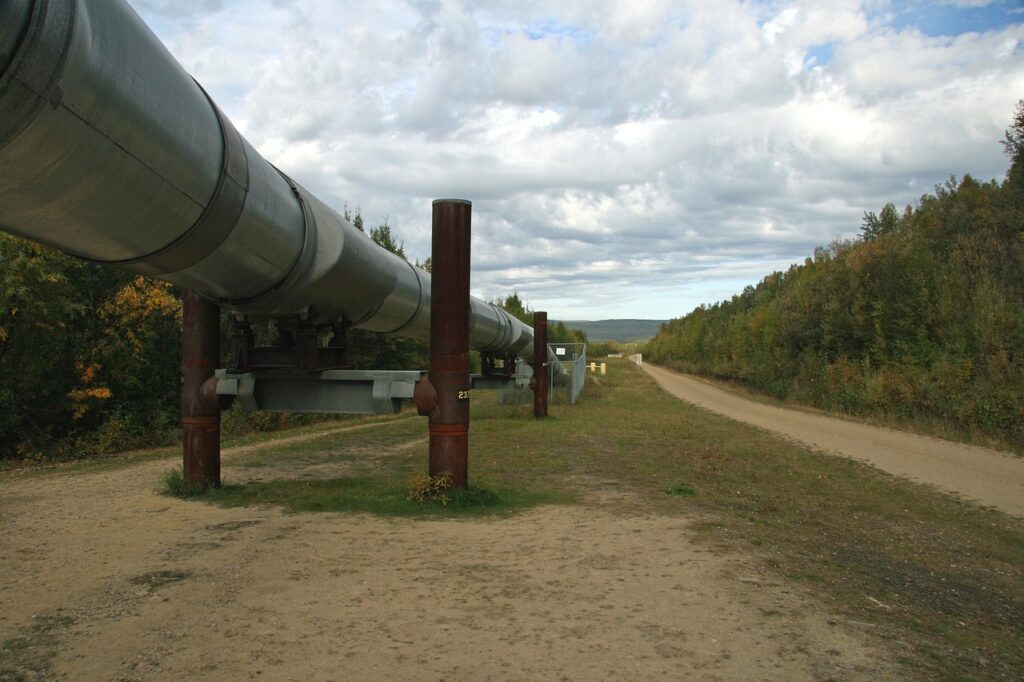
A business site of a few hectares in East Frisia: a fence, two halls, a bundle of pipelines, a cavern head. According to the standard land value and cost approach, this would be an unremarkable commercial property. In reality, the economic focus lies a thousand meters below – in a emptied-out cavity of several hundred thousand cubic meters, which is neither a building nor part of the land, yet still carries the entire cash flow.
Valuing caverns therefore begins with: clear separation. Above ground lies a real estate property, below ground lies a mining-law-approved use, and in between stands a contractual framework from which the revenues flow. Anyone who compresses these three levels into a single figure delivers a result without a solid legal basis.
The key point
The cavern is not a piece of land. The market value according to § 194 BauGB covers only the surface area; the storage cavity is subject to a mining-law operating plan approval and contractual agreements. The determining factor for value is not the volume, but the number of cycles that can be marketed with it – minus the custody obligation at the end.
What a cavern is – and what it is not for valuation purposes
A storage cavern is created by solution miningThrough a borehole, fresh water is injected into the salt; the resulting brine is pumped out until the desired cavity has been washed out. The process takes several years depending on the size.: In a salt dome or salt pillow, water is injected via a borehole and brine is pumped out until a cavity of typically 300,000 to 1,000,000 cubic meters has formed at a depth of 500 to 2,000 meters. Rock salt is the ideal host rock for this: practically gas-tight, creep-capable, and thus self-healing against cracks.
Legally, the peculiarity begins here. Rock salt, potash, and magnesium salts as well as brine are, according to § 3(3) BBergG subsoil minerals, ownership of the land does not extend to them. Anyone wishing to extract them requires mining law authorization, not merely a purchase agreement for the surface area. The resulting void then constitutes a subsurface storage facility within the meaning of Section 4(9) of the Federal Mining Act (BBergG), and Section 126 BBergG stipulates that extensive provisions of mining law apply mutatis mutandis – ranging from the obligation to submit an operating plan and construction restrictions to liability for mining damage.
Under civil law, Section 905 of the German Civil Code (BGB) applies: the landowner cannot prohibit intrusions at depths at which they have no interest in exclusion. In practice, subsurface uses are nevertheless regularly secured contractually – via easements and permission agreements, which, together with pipeline rights for brine and products, form part of the due diligence review in any valuation.
For valuation purposes, this results in a clear delineation.
| Level | Subject matter | Valuation framework |
|---|---|---|
| Above ground | Operating site, cavern entrances, compressor and drying plants, brine pipelines, access routes | Market value according to ImmoWertV; land based on standard land value, above-ground structures using the cost approach |
| Below ground | Storage cavity, mining law approvals, rights to the salt | No real property; to be recorded as a right and valued via the cash flow it enables |
| Contractual level | Storage contracts, bundled products, grid connection and feed-in contracts | DCF or periodic income approach |
The types of caverns and their significance for valuation
-
Natural gas caverns
- The standard case in Europe; marketing via standardized bundled products
- High injection and withdrawal capacity, ten or more cycles per year possible
- Returns follow spreads and volatility, not a fixed rent
-
Crude oil and product caverns
- Predominantly strategic stockpiling, often leased long-term to government entities
- Very stable, bond-like cash flow with low flexibility
- Withdrawal requires brine displacement – maintaining brine reserves is value-relevant
-
Hydrogen caverns
- Few industrial facilities, many pilot and conversion projects
- Value is generated only upon connection to a hydrogen network
- Material compatibility, gas conditioning, and microbiology are the technical bottlenecks
-
Compressed air storage
- Very small number of facilities, coupled to a power plant
- Revenue from ancillary services and arbitrage, not from storage leasing
- Valuation effectively as a power plant site, not as a storage facility
-
Brine and old caverns
- Cavities originating from salt mining or no longer in use
- Revenue-generating, but subject to ongoing monitoring and custody obligations
- Regular value deduction, no value contribution
Cavern sites in Europe
Storage caverns cannot be constructed wherever needed, but only where thick rock salt deposits are located at suitable depths. This is essentially the Zechstein belt, which stretches from northeast England through the Netherlands and northern Germany to Poland, supplemented by the French basins of Bresse and Provence and individual occurrences in Denmark and Portugal. The map shows significant sites, ordered by the predominantly stored medium.
-
1 Etzel Natural gas DEapprox. 3.9 billion m³ of gas + 10 million m³ of crude oil Friedeburg Storag Etzel Salt dome (diapir)
Approximately 75 caverns: natural gas in about 51, and a large portion of the national crude oil reserve in about 24 additional caverns. Since 2026, hydrogen has been stored as part of the H2CAST pilot project.
To the operator's website -
2 Epe Natural gas DEApprox. 3.5 billion m³ in 76 gas caverns Gronau Multiple operators Zechstein layer salt
Europe's largest cavern field with over 100 voids, alongside brine and crude oil caverns. Multiple operators within the same salt dome – a textbook case for delineating rights and areas of influence.
-
3 Jemgum Natural gas DEApprox. 900 million m³ of working gas East Frisia SEFE Storage, EWE Salt dome (diapir)
Younger cavern field near the Dutch border; two operators are to extract separate cavern rows within the same salt dome.
To the operator's website -
4 Huntorf Compressed air DEapprox. 300,000 m³ void volume, 290 MW Elsfleth Uniper Salt dome (diapir)
World's first compressed air energy storage plant, operational since 1978; conversion to hydrogen storage has been announced, pending funding approval and grid connection.
To the operator's website -
5 Bernburg Natural gas DEapprox. 1.0 billion m³ in 33 caverns Saxony-Anhalt VNG Gas Storage Zechstein rock salt, saddle structure
One of Europe's largest cavern storage facilities, in Staßfurt rock salt; high injection and withdrawal capacity, making it highly suitable for cyclical marketing.
To the operator's website -
6 Bad Lauchstädt Hydrogen DEapprox. 720 million m³ in 17 caverns Saxony-Anhalt VNG / Energy Park Zechstein rock salt
Natural gas storage and at the same time a reference project for green hydrogen: electrolysis, storage cavern, and pipeline connection at a single site – a rare case where the conversion does not fail due to connection issues.
To the operator's website -
7 Rüdersdorf Hydrogen DETest cavern with 500 m³ near Berlin EWE Salt dome (diapir)
Small research cavern in which cyclic operation with hydrogen was successfully tested; the basis for the conversion planning of larger fields.
To the operator's website -
8 Zuidwending Natural gas NLapprox. 310 million m³ in 5 caverns Veendam EnergyStock (Gasunie) Veendam Salt Dome (Diapir)
Dutch rapid-response storage facility designed for short-term flexibility; alongside it, the HyStock project is developing hydrogen caverns for the national H2 network.
To the operator's website -
9 Aldbrough Natural gas UKapprox. 330 million m³ in 9 caverns East Yorkshire SSE, Equinor Zechstein layer salt
Cavern field on England's east coast, directly at the landing point of the Norwegian import pipeline; the planned hydrogen usage is closely linked to the region's offshore wind capacity.
-
10 Stublach Natural gas UKapprox. 400 million m³ of working gas Cheshire Storengy UK Triassic salt layers, Cheshire Basin
Largest cavern storage facility in the UK, located in the Cheshire salt basin, historically originating from the brine industry – an example of how brine and storage caverns share the same reservoir.
To the operator's website -
11 Teesside Hydrogen UK3 caverns at approx. 70,000 m³ each Billingham Industrial operator Perm-Schichtsalz
Oldest hydrogen cavern storage facility in Europe: three shallow caverns have been supplying a chemical site since 1972 – the best available long-term evidence of salt's impermeability to hydrogen.
-
12 Manosque Crude oil FRapprox. 8 TWh of natural gas + oil reserves Provence Géosel / Géométhane Salt diapir (Oligocene)
Central site of the French strategic oil reserve, supplemented by natural gas caverns; connected to Mediterranean ports via dedicated pipelines.
To the operator's website -
13 Tersanne Natural gas FRapprox. 7 TWh in 14 caverns Drôme Storengy Trias rock salt
Oldest French cavern field, in operation since 1970; important peak-load storage for the Rhône Valley.
To the operator's website -
14 Etrez Natural gas FRapprox. 13 TWh in 28 caverns Ain Storengy Rock salt in the Bresse Basin
Largest French cavern field in the Bresse Basin, featuring one of the first European demonstrators for hydrogen storage in salt.
To the operator's website -
15 Lille Torup Natural gas DKApprox. 260 million m³ of working gas Jutland Gas Storage Denmark Salt dome (diapir)
Danish cavern field in a salt diapir; candidate for future hydrogen use in conjunction with Danish wind power generation.
To the operator's website -
16 Mogilno Natural gas PLApprox. 580 million m³ in 14 caverns Kuyavia Gas Storage Poland Mogilno Salt Dome (Diapir)
Largest Polish cavern storage facility in the Mogilno salt dome; significant expansion potential, including for hydrogen.
-
17 Kosakowo Natural gas PLapprox. 295 million m³ in 10 caverns near Gdynia Gas Storage Poland Bedded salt Mechelinki
Coastal location with brine discharge into the Baltic Sea – water law compliance is the critical factor for any expansion.
-
18 Carriço Natural gas PTapprox. 335 million m³ of working gas Pombal REN Armazenagem Monte Real Salt Diapir
The only underground storage facility on the Iberian Peninsula in salt caverns; the backbone of Portuguese supply security alongside the Sines LNG terminal.
To the operator's website
Significant cavern storage facilities in Europe by predominantly stored medium: natural gas (turquoise), crude oil (brown), hydrogen (blue), compressed air (purple). Also shown are the major transmission pipelines – blue for import and onshore lines, grey for domestic transport axes, dashed for routes currently not in transit; the routes are schematic, and the name appears when hovering over the line. The salt formation in which the caverns are located is also indicated – salt diapirs allow high, slender cavities, while flat-lying bedded salt forces flatter geometries. The selection is not exhaustive, the quantity figures are orders of magnitude as of 2026; 1 billion m³ of natural gas corresponds to approx. 11 TWh. Clicking on a list entry highlights the location on the map – and vice versa.
The map also shows the major transmission pipelines – and this is no mere detail. A storage facility without a high-capacity grid connection is economically worthless, and the locational advantage of the major fields is almost entirely explained by their location on the transport axes: Etzel and Jemgum are located at the Norwegian onshore points in Emden and Dornum, Epe at the connection to the Dutch and Belgian grid, Bernburg and Bad Lauchstädt at the central German axes, Aldbrough near the British onshore point in Easington. Whoever evaluates a cavern storage site is always also evaluating its connectivity.
In figures: Germany has around 30 cavern storage facilities with approx. 14 billion m³ of working gas, as well as 14 porous rock storage facilities with approx. 8.6 billion m³. However, the difference between the two lies less in the quantity than in the speed – and precisely this is the price driver.
Two locations deserve particular attention in valuation practice. In Etzel natural gas, crude oil, and since 2026 also hydrogen caverns are located next to each other in a single salt diapir – there, the delineation of rights, liability areas, and spheres of influence is not a theoretical question. And Teesside In England, nearly pure hydrogen has been stored since 1972 in three caverns. This constitutes the only decades-long practical evidence of the impermeability of salt formations to hydrogen, and is therefore a frequently cited argument in conversion appraisal reports.
Who operates the caverns – and who owns them
With cavern storage facilities, three roles diverge that, in the case of a conventional property, are consolidated under one roof: the landowner of the surface area, the holder of the mining rights and the cavity and the storage operator, who markets the capacity. Often, these are three different companies – and in Etzel, there are even several per level.
The Etzel site serves as a textbook example: STORAG ETZEL builds, maintains, and leases the voids, but does not itself engage in storage product sales. The caverns are leased to energy trading companies and to the oil stockpiling agencies of several European states; since 2020, a capital management company for German institutional investors – insurers, pension funds, foundations – stands behind it as a shareholder. Anyone commissioning an appraisal report here must first specify which of these positions is to be valued.
In the last column, the magnitude is stated before the dash, and what this implies for the valuation follows after.
| Operator | Role | Locations in the map | Size and significance – relevant for valuation |
|---|---|---|---|
| STORAG ETZEL | Cavern lessor | Etzel | Approximately 75 caverns in the Etzel salt dome, expansion potential up to 99 locations, largest independent provider of cavern storage space in Germany – leases void space rather than storage products; the shareholder is a fund vehicle for institutional investors. Model case for the separation of void and operation. |
| SEFE Storage (astora) | storage operator | Jemgum | Operates the Rehden gas storage facility alongside Jemgum, with a capacity of approximately 4 billion m³, representing about one-fifth of Germany's total storage capacity – fully owned by the Federal Government since November 2022. A politically mandated ownership structure influences the marketing strategy and, consequently, the revenue. |
| EWE Gas Storage | storage operator | Jemgum, Huntorf, Rüdersdorf | 37 caverns across four locations, collectively accounting for approximately 15 percent of Germany's cavern storage capacity – a pioneer in hydrogen testing, with the Rüdersdorf test cavern providing operational data for subsequent conversions. |
| Uniper Energy Storage | Storage operator, technical operation management | Huntorf, capacities in Etzel and Epe | Approximately 7.5 billion cubic meters of working gas at sites in Germany, Austria, and the United Kingdom; one of Europe's largest storage operators – since 2022, majority-owned by the Federal Government, operates Etzel on behalf of a consortium of additional companies. |
| VNG Gas Storage | storage operator | Bernburg, Bad Lauchstädt | At these two sites alone, 50 caverns with a combined working gas capacity of approximately 1.7 billion cubic meters – operates one of the few projects with a complete hydrogen value chain at a single site (Bad Lauchstädt). |
| RWE Gas Storage West | storage operator | Epe | Four underground storage facilities with approximately 1.5 billion cubic meters of working gas; in Epe, two hydrogen caverns with a capacity of approximately 38 million cubic meters are being constructed – representing Germany's first commercial hydrogen storage facility and thus the first case where a conversion is commercially priced. |
| Nobian | Salt producer, provides cavities | Epe, Zuidwending | One of Europe's largest salt producers; the brine caverns are a by-product of salt mining – the entity that creates the cavity is rarely the one that manages it later. |
| EnergyStock (Gasunie) | storage operator | Zuidwending | Five caverns with approximately 310 million cubic meters; the fastest storage facility in the Netherlands – a subsidiary of the Dutch transmission system operator; hydrogen caverns are being developed in the HyStock project. |
| SSE Thermal and Equinor | Joint venture | Aldbrough | Nine caverns with a total capacity of approximately 330 million m³, one of the two major British cavern storage facilities – expansion with hydrogen caverns planned, linked to the region's offshore wind capacity. |
| Storengy (Engie) | storage operator | Stublach, Tersanne, Etrez | Nine storage sites in France with a combined capacity of approximately 110 TWh, by far the largest storage operator in the country – in Etrez, HyPSTER, one of the first European hydrogen demonstrators in salt formations, is operating. |
| Géosel and Géométhane | Operator of oil and natural gas | Manosque | Approximately 8 TWh of natural gas, plus the central site of the French strategic oil reserve – two companies share a salt diapir, with the delineation of their respective areas of influence contractually regulated. |
| Gas Storage Denmark | storage operator | Lille Torup | Lille Torup with approximately 260 million m³ and the aquifer storage site Stenlille together constitute the entire Danish storage capacity – part of the Danish transmission system operator, with storage serving as an instrument of state supply security. |
| Gas Storage Poland | storage operator | Mogilno, Kosakowo | Operator of the entire Polish storage system; the two cavern facilities together hold approximately 875 million m³ – since 2024 under the transmission system operator GAZ-SYSTEM, following an antitrust unbundling requirement. |
| REN Armazenagem | storage operator | Carriço | Approximately 335 million m³, representing the full underground storage capacity of Portugal at a single site – part of the Portuguese network operator, implying a concentrated risk at the national level and accordingly high strategic importance for supply security. |
Three patterns emerge. First, a significant portion of European storage capacity is indirectly or directly in state ownership – partly historically as part of network operations, partly as a result of nationalizations and unbundling measures since 2022. For valuation purposes, this means: the commercialization strategy does not always follow profit maximization, which must be taken into account in the risk assessment.
Second, there is the cavern leasing model, a second business model alongside storage sales. Leasing caverns generates a rent-like, highly predictable cash flow and avoids spread and commercialization risks; selling storage products profits from volatility. Both models justify entirely different capitalization rates – and for this reason, an appraisal report must first specify which position it is valuing.
Third, the market is highly concentrated. In France, Denmark, Poland, and Portugal, practically all storage capacity is held by a single company; in Germany, a handful of operators share the portfolio. Comparable sales for entire storage facilities are therefore rare – another reason why valuation relies on cash flow rather than the market comparison approach.
The Value Driver: Not Volume, but Cycles
The obvious reference metric – cubic meters of void space – is the wrong one. Three other key figures are relevant to the market:
- Working Gas Volume – the actually usable quantity, i.e., the void space minus the permanently trapped cushion gas. Cushion gas represents tied-up capital and must be treated separately in the valuation, not concealed silently within fixed assets.
- Injection and Withdrawal Capacity – it determines how quickly the storage can be filled and emptied. Caverns typically achieve ten or more cycles per year, while porous rock storages usually manage only one to two. The market pays a premium for this speed.
- Marketable Cycles – the product of technical performance and the spreads the market offers. A technically excellent storage facility earns little in a year without summer-winter price spreads.
Crucial for the income side is a regulatory peculiarity: access to gas storage facilities is subject to § 28 of the Energy Industry Act (EnWG) negotiated access. Unlike network charges, storage fees are not subject to incentive regulation – there is no regulated capital return that could serve as a basis for valuation. The revenue is a pure market price, which justifies a significantly higher risk premium compared to regulated infrastructure.
At the same time, the state intervenes in marketing. The Gas Storage Fill Level Ordinance requires a fill level of 80 percent by November 1 – for six named facilities with lower capacity, only 45 percent – and 30 percent by February 1; it expires on March 31, 2027. Such requirements narrow the operator's scope for action and thus the achievable revenues. The applicable version depends on the valuation date.
Hydrogen: real option, not basic assumption
Hardly any topic is treated so generously in storage valuations currently as the conversion to hydrogen. Objectively, three questions must be distinguished.
Technically storage in salt caverns is proven. The effort lies not in the cavity itself, but in the peripheral infrastructure: piping and seals, compressors, drying and gas conditioning, as well as the microbiological conversion of hydrogen in the residual water of the cavern. Pilot projects in Etzel, Rüdersdorf, Bad Lauchstädt, and Etrez are working precisely on these aspects.
Economically the connection is decisive. A converted cavern without a connection to a hydrogen network and without off-takers generates not a single euro of revenue. It is the same dependency that also applies to Data centres and in the open-space photovoltaics the value is determined not by the installation itself, but by the secured grid connection.
Methodologically therefore, the retrofit should not be included in the base value. The appropriate treatment is to classify it as a real option: a separately derived value contribution or a dedicated scenario in the DCF model, with the probability of occurrence, retrofit costs, and connection date clearly disclosed. An appraisal report that incorporates the hydrogen pathway unweighted into the cash flow no longer constitutes a valuation, but rather a statement of intent.
Which method is appropriate
| for the | scenario | Notes |
|---|---|---|
| Above-ground operating site, to be valued separately | Cost approach including land value derived from the standard land value | Without the storage function, the area constitutes ordinary commercial land; demolition obligations reduce |
| Storage facility in operation with ongoing storage contracts | DCF method, additionally Income approach in accordance with §§ 27 et seq. ImmoWertV | Uneven cash flows support the periodic method under § 30 ImmoWertV |
| Cavern in dissolution or planned expansion | Residual value calculation and investment appraisal | Critical factors include service life, brine disposal, water law regulations, and the connection deadline |
| Overall storage operation as a single unit | Business valuation in accordance with IDW S 1 | Not a market value appraisal; the properties constitute only a partial asset within it |
The choice of method follows § 6 ImmoWertV, i.e., market behavior. Buyers of storage facilities consistently base their calculations on cash flows; the cost approach serves for plausibility checks and tax allocation, not for determining the value.
The cost factor that erodes value: Custody and aftercare
No other factor is so frequently underestimated in cavern valuations as the end of use. A cavern does not simply disappear when the contract expires – it must be secured, monitored, and kept permanently stable. Salt creeps: the void converges over decades, and the operator bears the consequences at the surface.
Four points therefore belong expressly in every appraisal report:
- Custody and demolition costs – Backfilling or brine filling, demolition of surface facilities, long-term monitoring. For multiple caverns, these amounts can easily reach the magnitude of the income value of individual years.
- Mining law security deposit – the authority can make the approval of an operating plan pursuant to Section 56(2) of the Federal Mining Act (BBergG) contingent upon a security deposit. Provided securities tie up capital and must be included in the assessment.
- Mining damage risk – within the area of influence, the presumption of mining damage under Section 120 of the Federal Mining Act (BBergG) applies: subsidence, compression, or ground fissures are attributed to the mining operation until proven otherwise. This is a genuine, quantifiable risk, not a peripheral issue.
- Provisions – provisions for custody established under commercial and tax law must be reconciled with the costs set out in the valuation model. If the two differ, the appraisal report must explain the discrepancy.
Where these liabilities affect the property itself, they must be reflected as a specific property characteristic pursuant to Section 8(3) of the German Valuation Ordinance (ImmoWertV) via a market-standard discount – not hidden in the property yield rate.
Water law as a hidden bottleneck
Every extraction and every brine displacement requires water and generates brine. Withdrawal and discharge permits under the Water Resources Act (WHG) are time-limited, quantitatively restricted, and increasingly contentious in new applications – both for coastal sites and inland locations. If the permit for the next expansion is missing, the geologically available reserve is economically worthless.
Valuation law classification: Building, operating equipment, or neither
For property tax, purchase price allocation, and depreciation, the classification of the facility components is decisive. The cavity itself is not a building – it does not allow human occupancy and does not constitute a structural facility within the meaning of valuation law. Cavern heads, compressors, drying and measuring equipment, brine and product pipelines serve the operation directly and are therefore regularly operating equipment under Section 68(2)(1) No. 2 of the Real Estate Valuation Act (BewG), which do not belong to the land assets. Components with dual functions – such as an operating building that also houses facilities – remain assigned to the land assets under Section 68(2)(2) BewG.
In practice, this means: The property tax value and the real estate economic value of a cavern site differ significantly, and both are far removed from the enterprise value. An appraisal report must disclose which of the three values it determines.
Typical valuation occasions
- Transaction and Due Diligence – Review of entitlements, operational plans, storage contracts, water rights, and custody obligations.
- Financing – in the mortgage lending value report under the Mortgage Lending Value Ordinance (BelWertV), the lack of third-party usability has a direct impact; a storage site without storage operations constitutes a decommissioning obligation with a fence.
- Financial Reporting – fair value measurement under IFRS 13, impairment testing, and the valuation of provisions under IAS 37; details in the article on real estate valuation for financial statements.
- Taxation – purchase price allocation, depreciation, and property tax based on the distinction between real property and operating equipment.
- Compensation and Rights – Determination of easements, compensation for permissions, and compensation for mining damage.
- Project development – Feasibility study and project cost calculation for new construction or retrofitting, as long as water law and grid connection issues remain unresolved.
What a robust appraisal report must contain
- the Definition of the valuation subject matter: property, right, or enterprise – explicitly stated, not implied,
- the mining law position with entitlements, approved operating plans, durations, and security deposits,
- the Working Gas Volume separate from cushion gas, with specification of injection and withdrawal capacity,
- the Derivation of the storage fee from contracts and market data, with specification of the assumed number of cycles,
- the water law permits for withdrawal and brine discharge with time limits and volume restrictions,
- the Custody and post-closure costs with timing, amount, and discounting, reconciled with the accounting provisions,
- the hydrogen pathway as a separately identified scenario, not as part of the base value,
- a sensitivity analysis for spread, cycle count, conversion costs, and discount rate.
Conclusion
Valuing caverns means distinguishing between three elements that are often conflated in common parlance as a single entity: the surface area, the legally permitted underground cavity, and the storage operations that link the two. Only the first constitutes a parcel of land within the meaning of the ImmoWertV.
The value is determined not by the size of the cavity, but by the number of cycles that can be marketed with it, the security of the water and mining law permits, and the question of what the storage will ultimately cost. The hydrogen pathway can significantly increase this value – but only if grid connection and offtake are secured. Until then, it belongs in a scenario, not in the base case.
The same separation of facility, connection right, and operation also characterizes other technical special-purpose properties – such as industrial properties and event arenas and stadiums.
Please note: the content of this article is provided for general information only and does not constitute legal, tax, financial or investment advice. It is not a substitute for individual advice from a licensed lawyer, tax adviser or financial adviser. Despite careful research, we accept no liability for the accuracy, completeness or currency of the information provided. For specific legal or tax questions, please consult a qualified professional adviser.